I laughed (along with lots of people) at Harold Camping's apocalyptic prediction this week. On Sunday afternoon I told my family I would be leaving them soon, and at 6:00 that night--when the rapture was supposed to start--I said, "I feel like I'm floating." The jokes about these supposed ends of the world are themselves endless.
But then on Tuesday The New York Times ran two articles together: one on Camping's revised prediction that both the rapture and the world's end will arrive now on October 21, and one on the aftermath of the Joplin tornado--the search for the living and the dead. In reading the articles I realized that the monster tornado hit Joplin around the same time that Camping's saved souls were supposed to be ascending to heaven. At around the same time that the rest of us would begin our hell on earth.
Which is exactly what happened in Joplin, Missouri.
We don't need firebrand preachers and Bible-waving soothsayers to remind us that the end of the world arrives every day for someone somewhere on the globe. If we forget, we're quickly reminded by storms or by illness or by death.
If the rapture ever comes, it will surely take all of us for none of us deserves the suffering we endure. It's part of being human.
Showing posts with label Tsunami. Show all posts
Showing posts with label Tsunami. Show all posts
Thursday, May 26, 2011

Thursday, March 24, 2011
Spring Reflections
Sometimes I wonder how much Mother Earth can take--with missiles exploding in Libya and radioactive iodine leaching into the water of Tokyo. Yet here in North Carolina spring has arrived with its usual beauty.
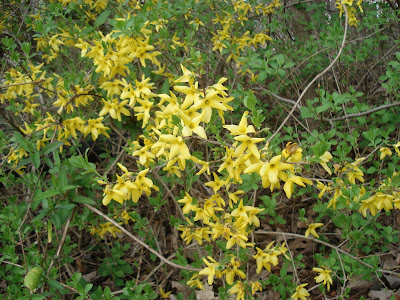
Named for the 18th-century Scottish botanist William Forsyth, forsythia is native to China. Oddly enough, its flowers can produce lactose. For me, forsythia is forever linked to tennis, for as a child I practiced hitting tennis balls against the side of our garage next to these brilliant yellow flowers.
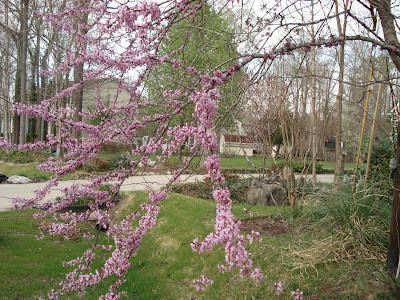
The eastern redbud, or Judas tree, comes from the Greek word for weaver's shuttle. Supposedly the tree upon which Judas Iscariot hung himself, the original white flowers turned red with blood and shame--though the flowers as we know them are pink. Perhaps, then, the suicide is meant to be seen as a more muted and nuanced event, and not as a stark or harsh act suggested by the color of blood.
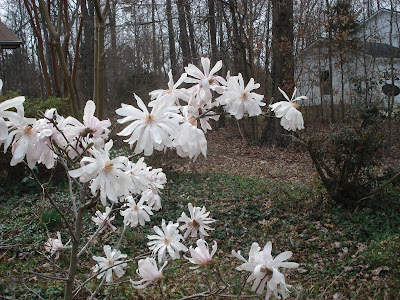
The star magnolia is native to Honshu, Japan's largest island. Off its coast is where the earthquake hit and the tsunami began.
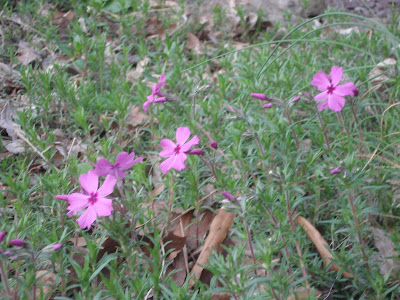
Phlox comes from the Greek word for flame, closely related to the word phlegein, which means "to burn"--kind of like Libya and Japan.
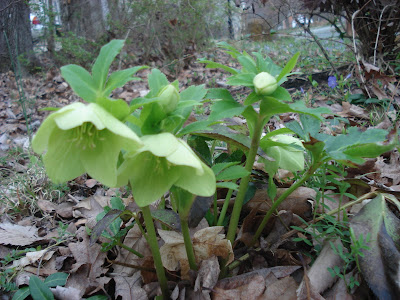
The helleborus, or Lenten rose, is not a rose. Many of its species are poisonous, and it was used in witchcraft to summon demons. In Greek mythology, though, Melampus of Pylos used hellebore to save the daughters of the king of Argos from madness.
Maybe nothing is as it seems. Maybe, in the end, all we see is "through a glass, darkly," as the Apostle Paul tells us.
It's just that in the spring the colors are so beautiful. So heartbreakingly beautiful.

Named for the 18th-century Scottish botanist William Forsyth, forsythia is native to China. Oddly enough, its flowers can produce lactose. For me, forsythia is forever linked to tennis, for as a child I practiced hitting tennis balls against the side of our garage next to these brilliant yellow flowers.

The eastern redbud, or Judas tree, comes from the Greek word for weaver's shuttle. Supposedly the tree upon which Judas Iscariot hung himself, the original white flowers turned red with blood and shame--though the flowers as we know them are pink. Perhaps, then, the suicide is meant to be seen as a more muted and nuanced event, and not as a stark or harsh act suggested by the color of blood.

The star magnolia is native to Honshu, Japan's largest island. Off its coast is where the earthquake hit and the tsunami began.

Phlox comes from the Greek word for flame, closely related to the word phlegein, which means "to burn"--kind of like Libya and Japan.

The helleborus, or Lenten rose, is not a rose. Many of its species are poisonous, and it was used in witchcraft to summon demons. In Greek mythology, though, Melampus of Pylos used hellebore to save the daughters of the king of Argos from madness.
Maybe nothing is as it seems. Maybe, in the end, all we see is "through a glass, darkly," as the Apostle Paul tells us.
It's just that in the spring the colors are so beautiful. So heartbreakingly beautiful.
Subscribe to:
Posts (Atom)